
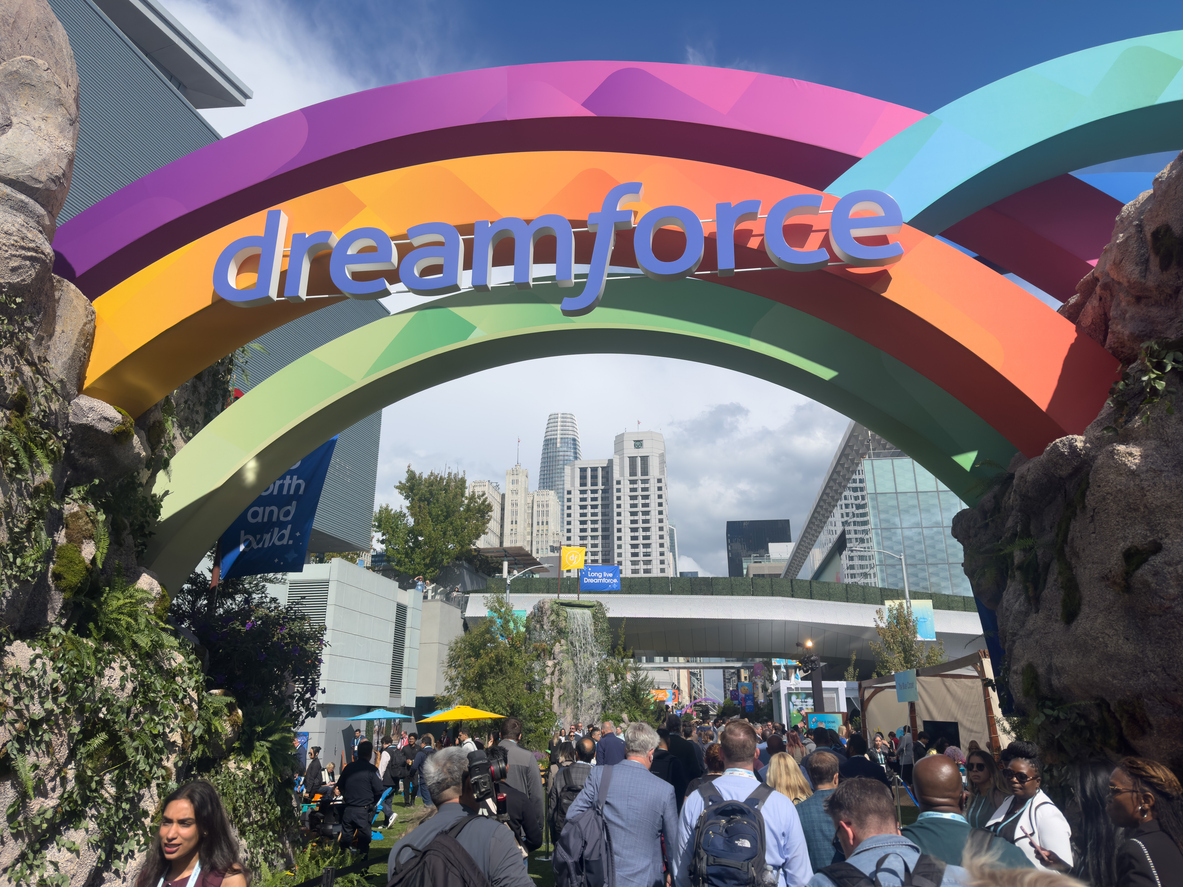
For years, CRM systems have served as systems of record. At Dreamforce 2026, Salesforce made it clear it wants to become something much bigger: a system of action powered by AI. Between the introduction of AIforce, the launch of a CRM-specific reasoning model called Koa, and expanded partnerships with Google Cloud and AWS, Salesforce’s message was consistent throughout the week: the future of work won’t revolve around applications. It will revolve around intelligent agents.
AIforce Wants Salesforce Everywhere
The headline announcement was AIforce, a new interface layer designed to bring Salesforce’s data, workflows, security model, permissions, and business logic into virtually any AI experience. Instead of requiring users to log into Salesforce, AIforce allows people and agents to interact with Salesforce from tools like Slack, Claude, and other AI environments while still operating within Salesforce governance controls.
The practical implication is significant. Sales teams could update opportunities, service teams could resolve cases, and executives could access business insights without opening another dashboard. Salesforce is essentially betting that the next generation of user interfaces won’t be screens and menus. They’ll be conversations and agents.
Meet Koa, Salesforce’s CRM-Trained Brain
Of course, giving agents access to enterprise data is only useful if they can reason through it effectively. That’s where Koa comes in.
Built with NVIDIA and based on NVIDIA Nemotron technology, Koa is Salesforce’s first CRM-specific reasoning model. Unlike general-purpose AI models, Koa was trained using synthetic enterprise scenarios modeled after nearly three decades of CRM processes and business workflows. The goal is to help agents reason through complex, multi-step business activities such as opportunity management, customer service resolution, scheduling follow-ups, and routing cases.
Perhaps most notably, Salesforce claims Koa matches or exceeds leading model performance on CRM actions while producing three times fewer errors in its CRM benchmark testing. That’s the difference between an AI assistant that sounds convincing and one that can reliably help move work forward.
Salesforce is Switzerland in the AI Wars
Another theme emerged from several announcements: Salesforce wants customers to have options.
Its expanded partnership with Google Cloud allows Salesforce workloads to run on Google Cloud infrastructure while enabling Gemini Enterprise and Agentforce agents to share data, reasoning, and actions across platforms. Organizations can access Salesforce capabilities directly inside Gemini Enterprise and leverage Google models inside Agentforce.
At the same time, Salesforce deepened its relationship with AWS. New integrations bring Salesforce data and context into Amazon Quick, allow AWS agents to work directly inside Slack, expand Agentforce access to foundation models through Amazon Bedrock, and strengthen zero-copy data access across AWS and Salesforce environments.
In plain English, Salesforce is telling customers they shouldn’t have to choose between cloud providers, AI models, collaboration platforms, and CRM investments. The company wants its data and business context to travel freely across them all.
What Dreamforce Means for the Future of AI Adoption
The biggest takeaway isn’t that Salesforce announced more AI capabilities. Everyone is announcing AI capabilities.
The bigger story is that Salesforce is attempting to make AI operational. AIforce brings CRM intelligence into the tools where work already happens. Koa gives agents a business-specific reasoning engine.
Partnerships with Google and AWS help remove many of the integration barriers that have historically slowed enterprise adoption.
Will this instantly create the “agentic enterprise” Salesforce envisions? Not on its own. Data quality, governance, process maturity, and user adoption still matter as much as ever. But Salesforce has made its direction unmistakably clear. The company isn’t trying to build another AI feature. It’s trying to build a workforce of AI agents that can understand context, collaborate across systems, and help people get work done.
And judging by this year’s Dreamforce announcements, that future may be arriving faster than many organizations expected.
