Home » Nonprofit Salesforce Capacity Building: How Project Self-Sufficiency Cleaned Up Legacy Automation and Secured Its Org
Nonprofit Salesforce Capacity Building: How Project Self-Sufficiency Cleaned Up Legacy Automation and Secured Its Org
At a Glance
Project Self-Sufficiency, a Northern Colorado nonprofit serving single-parent families, ran programs, fundraising, and constituent management on a Salesforce org weighed down by unused packages, outdated automations, duplicate records, and excessive administrator access. CRMF delivered a capacity-building engagement focused on legacy automation cleanup, package removal, a security review, and knowledge transfer. The result: a cleaner, more secure, better-documented org the team can maintain with confidence.
Background: A Mission That Runs on Salesforce
Most nonprofits do not set out to build a messy Salesforce environment. It happens the way clutter always happens. A package here, a workflow rule there, a quick fix during a busy fundraising season, and a few years later nobody is quite sure what is connected to what.
That is where Project Self-Sufficiency found itself. The organization helps single-parent families in Northern Colorado build stability and independence, and Salesforce sits at the center of that work as the platform for program operations, fundraising, reporting, and constituent data. But the environment had grown complicated enough that even small changes felt risky.
CRMF stepped in to fix that. Not with a rebuild, but with a focused effort to understand the environment, clean it up, and hand the team a platform they could actually maintain.
The Challenge: Technical Debt Makes Every Change Risky
When a Salesforce org collects years of technical debt, the cost is not always obvious. It shows up as hesitation. Staff avoid changes because they cannot predict what might break, data quality slips, and security gaps go unnoticed.
Program and fundraising work never stops, so the team worried that any change might disrupt processes they could not afford to lose. Project Self-Sufficiency needed clarity before it needed anything else.
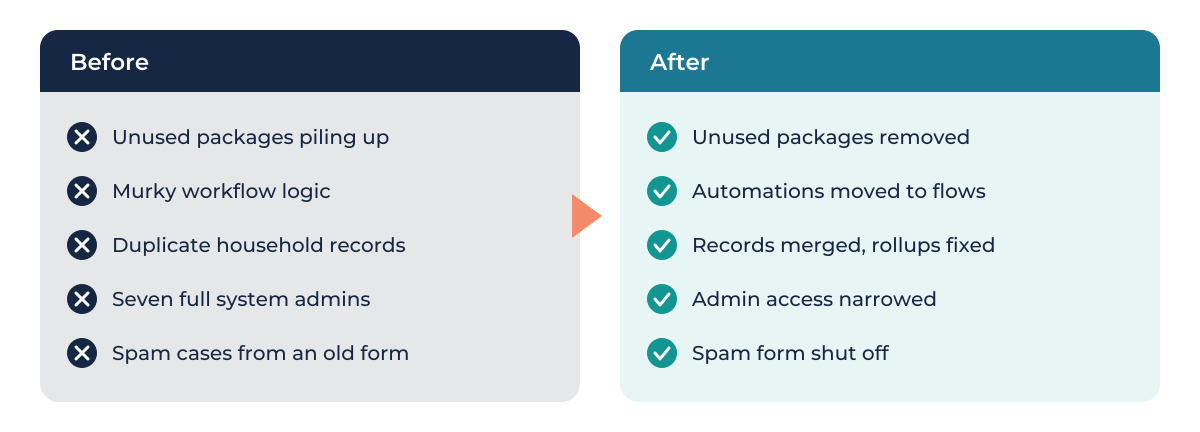
- Legacy packages nobody used. Old third-party packages added complexity with no value.
- Outdated automations. Workflow rules and Process Builders had murky logic and no documentation.
- Duplicates and households. A Salesforce update muddied constituent, donation, and case data.
- Unclear dependencies. Nobody had a map of how packages, fields, and records connected.
- Too much admin access. Seven users held full system administrator privileges.
- Spam cases. An unused Web-to-Case form was quietly filling the system with junk.
- Fear of breaking things. Live processes made every change feel risky.
The Solution: Assess, Document, Reduce Risk, Hand Off
CRMF delivered a capacity-building engagement built around four things: assessment, documentation, risk reduction, and knowledge transfer. The goal was not just to fix the environment. It was to leave the team understanding it well enough to keep it healthy.
Every change was validated in Sandbox before it touched Production, so the day to day active program and fundraising work stayed uninterrupted.
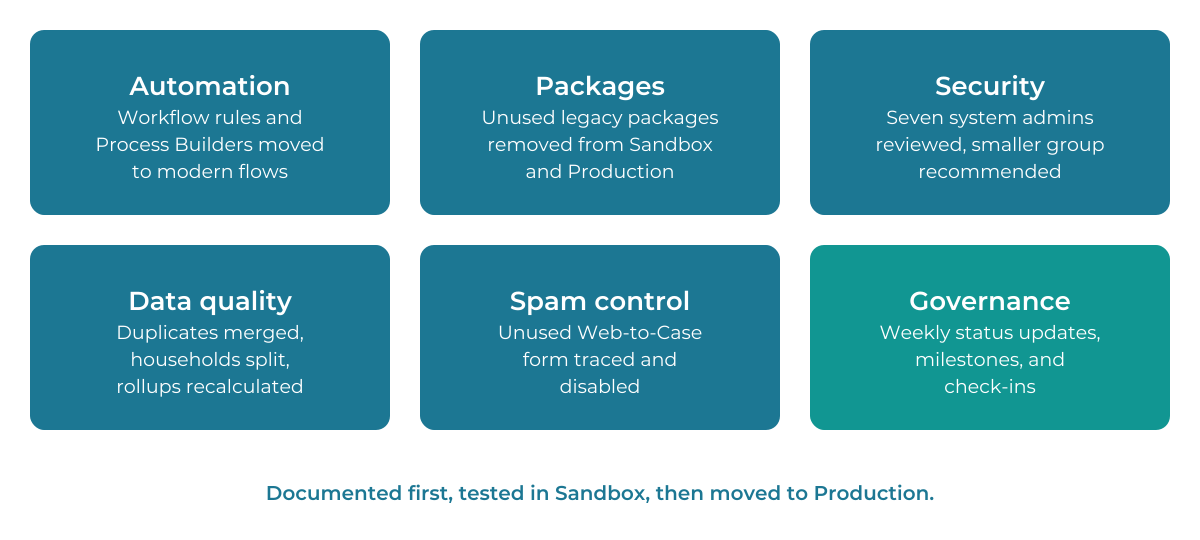
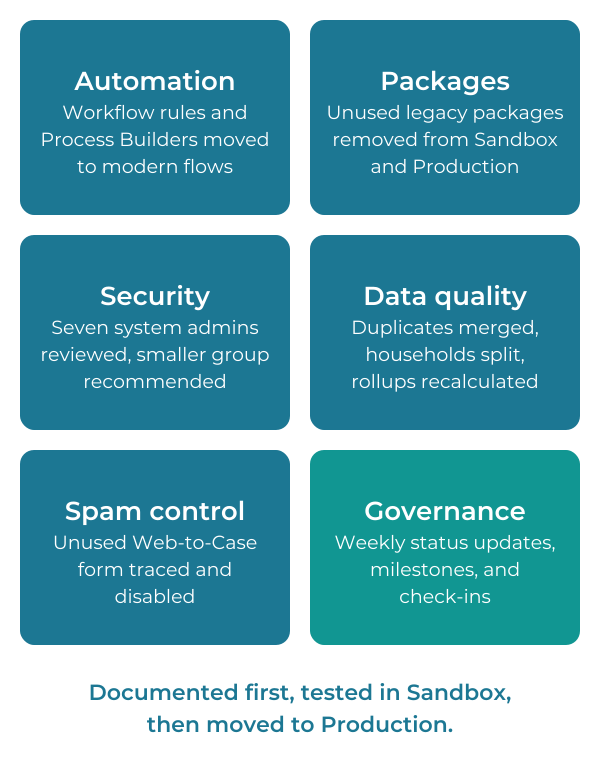
- Flow migration. Every automation documented, then legacy workflow rules and Process Builders moved to modern flows.
- Package removal. Each legacy package reviewed, with unused ones removed from Sandbox and Production.
- Security review. Over permissioned users audited, with a smaller group recommended and implemented.
- Households and duplicates. Records merged with cases and donations preserved, blocked splits fixed, rollups recalculated.
- Spam remediation. The unused Web-to-Case form was traced as the source and disabled.
- Project governance. Weekly and biweekly updates, tracked milestones, and recurring check-ins.
How the Project Ran
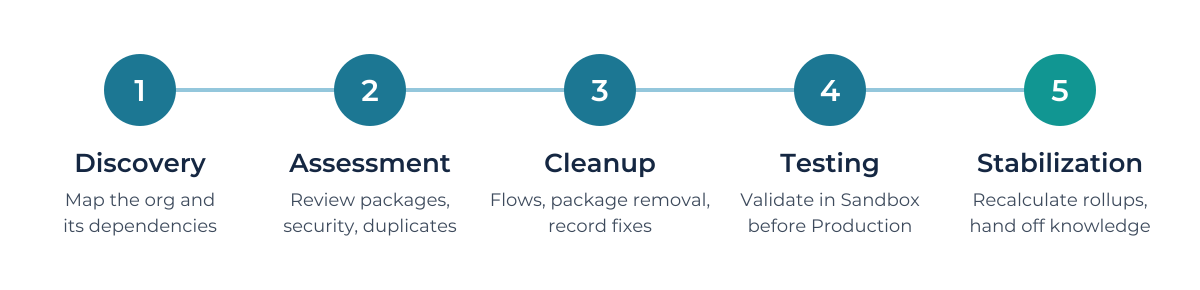
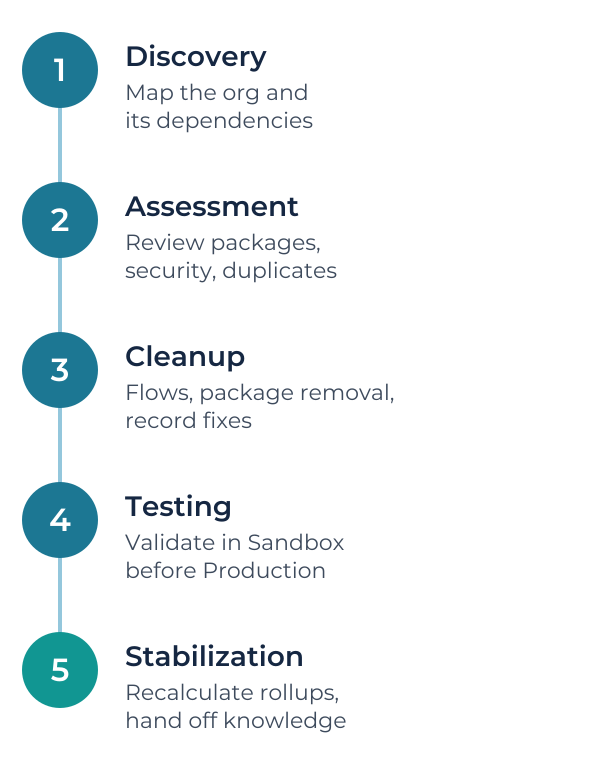
Five phases took the team from discovery to a stable, documented org, with Sandbox testing before every change reached Production.
Engagement Snapshot
Client type
Northern Colorado nonprofit serving single-parent families
Services provided
Salesforce capacity building, automation migration to flows, legacy package removal, security review, duplicate and household-record support, Web-to-Case remediation, project governance
Core platforms
Salesforce
Results: From Reactive Fixes to a Sustainable Operating Model
Project Self-Sufficiency moved from a reactive approach to a sustainable Salesforce operating model. Staff no longer avoid updates out of fear that something invisible will break. Automations live in modern flows the team can read, administrator access has a clear path to being scoped to the people who need it, and Sandbox testing means changes get validated before they touch live program and fundraising work. Most importantly, the team now understands how the environment works and how to keep it healthy.
Questions About This Project
What is Salesforce capacity building?
Salesforce capacity building is a focused engagement that cleans up and documents an existing org, then helps the team maintain it. For Project Self-Sufficiency, that meant moving legacy automations to flows, removing unused packages, reviewing security, and transferring knowledge, not rebuilding the org.
Why replace workflow rules and Process Builders with flows?
Workflow rules and Process Builders are legacy automation tools. CRMF documented every existing automation at Project Self-Sufficiency, including the unmanaged ones, then moved them to modern flows so the team can see, maintain, and extend their automation.
How do you remove unused Salesforce packages safely?
CRMF reviewed each legacy package, identified what was actually unused, and coordinated removal in Sandbox first and then Production. Mapping dependencies up front meant active program and fundraising processes were not interrupted.
Why does it matter that seven users had system administrator access?
Full system administrator access is more than most people need, and it puts sensitive constituent data at risk. CRMF recommended narrowing it to a smaller, manageable group while preserving the access people genuinely needed, which means a smaller attack surface and cleaner accountability.
The Takeaway
A cluttered Salesforce environment does not announce itself. It creeps in through unused packages, aging automations, and permissions nobody revisits, until the platform meant to support your work becomes something you are afraid to touch. Project Self-Sufficiency broke that cycle by investing in the foundation, not just the symptoms.
Through focused assessment, careful cleanup, security recommendations, and hands-on knowledge transfer, the organization turned a complex environment into one that is stable, secure, and manageable.
If your Salesforce environment has collected years of complexity, or you want to move from reactive fixes to sustainable platform management, book a consultation to talk through what a capacity-building engagement could do for your team.
Book a Consultation
