Home »
Agentforce and Contact Center AI: How a Health Benefits Organization Unified Member Data from 15 Systems
At a Glance
A healthcare and insurance benefits organization needed to modernize its contact center and give agents a single view of member data scattered across 15 claims and source systems. CRMF led a phased engagement that began with a technology advisory and roadmap, then delivered Salesforce AI and Contact Center AI enablement with Agentforce and Aircall CTI, a secure cloud data warehouse on Azure and Snowflake, Data 360 activation inside Salesforce, and Tableau analytics. Agents now see claims data from 15 systems on one screen, calls are recorded and transcribed automatically, and leadership can report on trends across previously disconnected data.
Background: AI Needs Data You Can Trust
You cannot put AI to work on a contact center that runs on scattered data. If an agent has to search three claims systems to answer one member question, adding a chatbot will not fix the real problem. It just adds one more screen.
That is the trap this organization wanted to avoid. Its service team handles member calls that touch claims, eligibility, and account details every day, and each slow lookup costs time, accuracy, and member trust.
Leadership saw real potential in Salesforce AI, Agentforce, and a modern contact center. Before committing to any platform, they wanted clear answers to a few practical questions. What does the business actually need? Is our data ready? Where are the security risks? CRMF answered those first, then built on the answers.
The Challenge: A Complicated Environment With High Stakes
The service environment had grown complicated in ways that made modernization risky without a plan. Left unaddressed, every new tool would sit on a shaky base. The organization needed a foundation before it needed features.
Member and claims data also demands strict access controls, so any new data architecture had to protect sensitive information from the start.
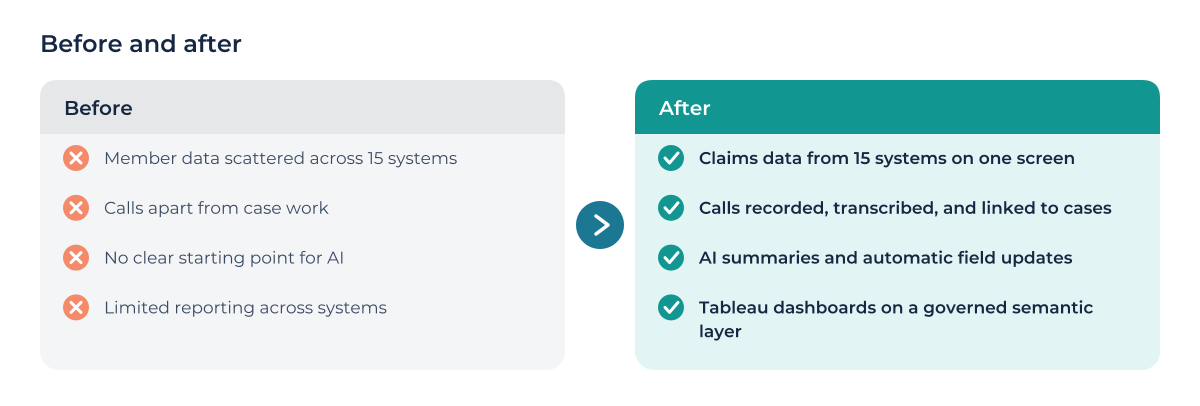
- Member data in 15 sources. Agents had to search multiple claims systems to piece together a member’s story.
- Telephony apart from service work. Calls, recordings, and case details did not connect, so agents spent time documenting instead of resolving.
- No clear AI starting point. Agentforce, Salesforce Voice, and other tools looked promising, but no one had mapped which use cases would deliver value.
- Limited management reporting. Leadership lacked a reliable way to measure service quality and performance across systems.
- Org health and security. Legacy automation, profile-based access, unused metadata, and undocumented custom pages made the org harder to manage and secure.
- High regulatory stakes. Sensitive member data required access controls built in from the start.
The Solution: A Phased, Business-First Program
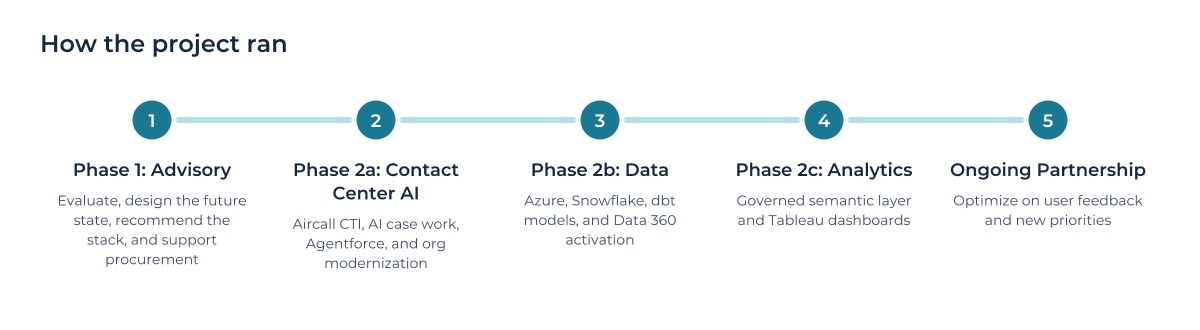
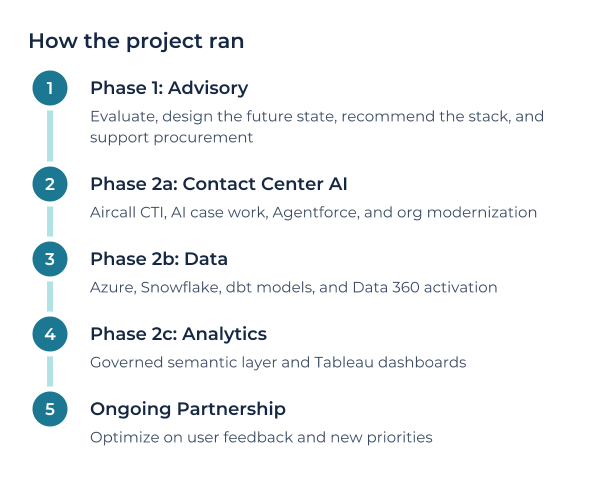
CRMF delivered a phased program. Phase 1 defined the strategy, and Phase 2 put it into production across three connected workstreams. Each step built on the one before, so the organization never invested in a capability it was not ready to use.
One recommendation shaped everything that followed. Salesforce Voice is a large, complex offering. Implementing it alongside an AI rollout, a data warehouse, and an analytics build would have been too much change at once, so CRMF recommended an Aircall CTI integration instead.
- Phase 1: advisory and roadmap. A current-state review, a future-state vision, a right-fit technology stack, and procurement support.
- Phase 2a: AI and contact center enablement. Aircall CTI with automatic recording, transcription, and case linking, AI case summaries, Agentforce guidance, and a call-aligned case layout.
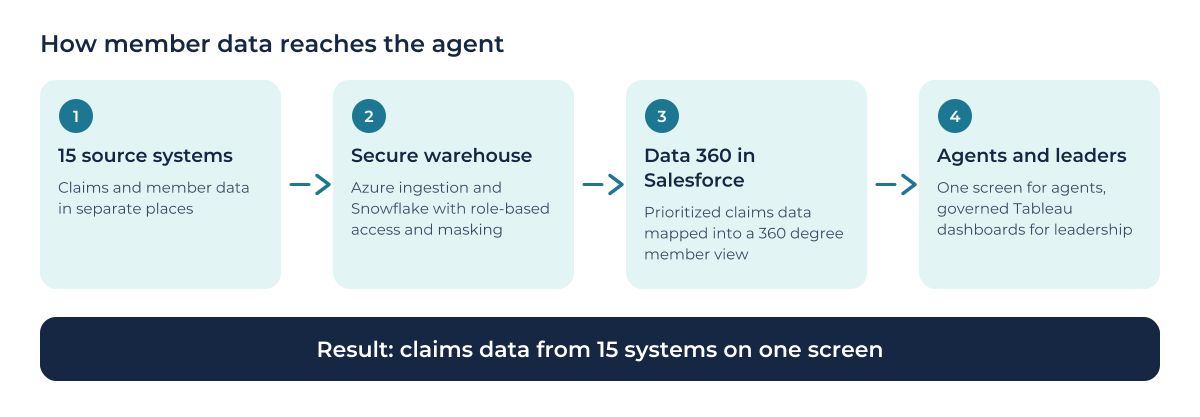
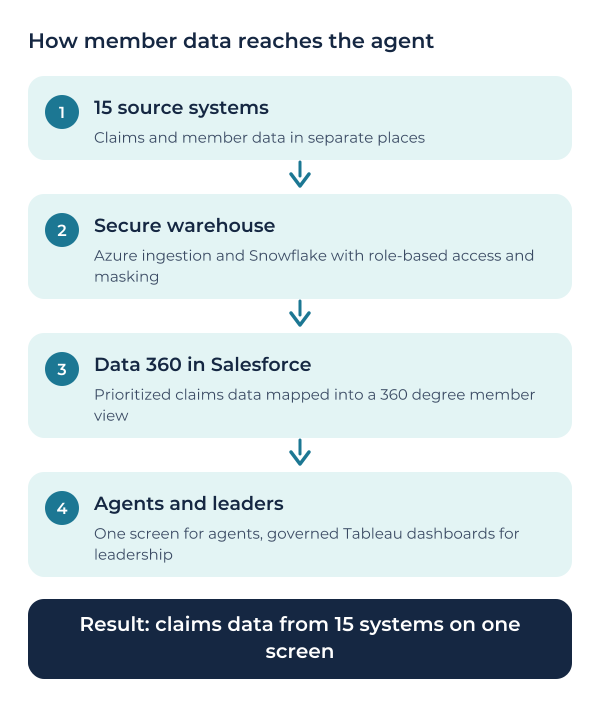
- A 360 degree member view. Prioritized claims data now appears inside Salesforce through Data 360.
- Phase 2b: data warehouse and Data 360. Secure Azure ingestion, Snowflake with role-based access and dynamic masking, dbt models, and data activation in Salesforce.
- Phase 2c: Tableau analytics. A governed semantic layer and dashboards for service, member, and claims reporting, with role-based training.
- Org health. Automation moved to Flow, access moved to permission sets, unused metadata was removed, and lightweight DevOps supported three concurrent workstreams.
How the Project Ran
Phases ran in order, from advisory through AI enablement, the data warehouse, and analytics, followed by an ongoing partnership.
Engagement Snapshot
Client type
Healthcare and insurance benefits organization
Services provided
Technology advisory, Salesforce AI and Contact Center AI enablement, Agentforce, Aircall CTI, Data 360, cloud data warehouse, Tableau analytics, security remediation, DevOps and governance
Core platforms
Salesforce, Agentforce, Data 360, Aircall CTI, Azure, Snowflake, dbt, Tableau
Results: One Screen, One Source of Truth
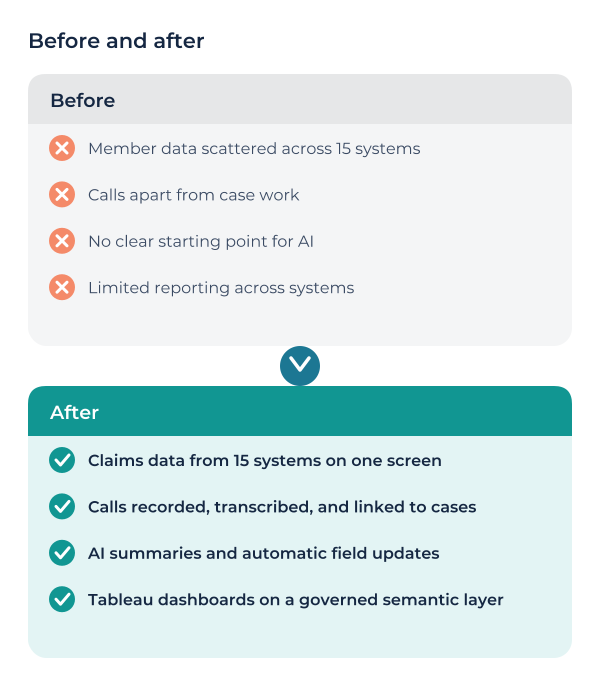
Service agents now see claims data from 15 different systems on a single screen. Calls are recorded and transcribed automatically, AI handles case summaries and field updates, and quick access to knowledge speeds up resolution. Leadership can report on trends across disparate data sources to make informed decisions, all on a secure, well-architected Salesforce foundation built for future growth.
The change shows up first on the phone. Agents no longer bounce between claims systems while a member waits, and AI takes care of the documentation that used to eat up time after every call. When a new issue comes up, agents can turn it into a draft knowledge article, so the next person who hears that question already has an answer.
Underneath it all, the org got stronger. Automation runs on current frameworks, access follows least privilege, and technical debt has been reduced where it mattered.
Questions About This Project
What does it mean to unify data from 15 systems?
Claims and source data is loaded into a secure cloud warehouse, activated in Salesforce through Data 360, and shown to agents on a single screen so they no longer search multiple systems.
Why Aircall instead of Salesforce Voice?
Salesforce Voice is large and complex, and implementing it alongside AI, a data warehouse, and analytics would have been too much change at once. Aircall CTI delivered recording, transcription, and case linking without overloading the team.
How is sensitive member data protected?
The warehouse uses role-based access controls and dynamic masking, and the Salesforce org moved to a least-privilege permission set model.
Where should an organization start with contact center AI?
With strategy and data readiness. This engagement began with an advisory phase and roadmap before any build, so each tool had a clear role.
The Takeaway
AI in the contact center is only as good as the data underneath it. AI learns as it goes, but it struggles with ambiguous terms and inconsistent records. The more structured your data and the more consistent your language, the better your results.
This organization got that order right. It started with strategy, built a secure data foundation, and then layered AI and analytics on top. CRMF guided each step, including hard calls like choosing an Aircall integration the team could adopt without overload.
If your organization wants to bring Agentforce, Salesforce AI, or a unified member view into your contact center, but you need a clear plan before you commit, book a consultation with CRMF to talk through what a phased, business-first approach could do for your team.
Book a Consultation
